Biochemist Syllabus
Biochemist Syllabus राजस्थान लोक सेवा आयोग, अजमेर ने जारी किया भर्ती परीक्षा का पाठ्यक्रम, राजस्थान लोक सेवा आयोग ने बायोकेमिस्ट पद के लिए प्रतियोगी परीक्षा का सिलेबस किया जारी, बायोकेमिस्ट परीक्षा का पाठ्यक्रम और टॉपिक इस आर्टिकल मे दिया गया है। बायोकेमिस्ट परीक्षा पाठ्यक्रम की पीडीएफ़ का लिंक इस आर्टिकल के अंत में दिया गया है। दिए गए लिंक से या ऑफिसियल वेबसाईट से पीडीएफ़ डाउनलोड कर सकते है।
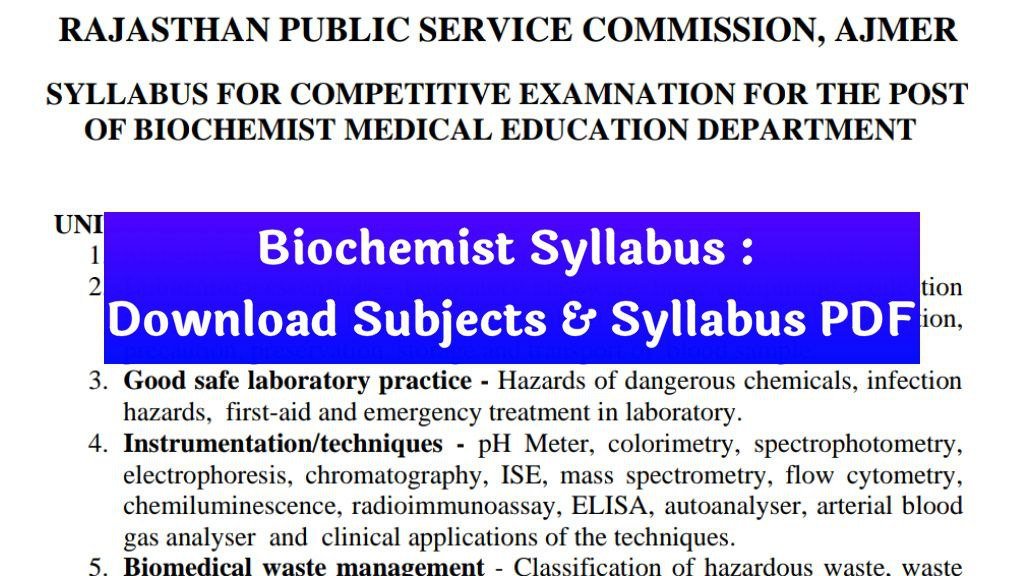
Scheme of examination for the post of Biochemist
(i) Written Examination – 150 Marks
| Subject | No. of Questions | Total Marks | Examination Duration |
| Concerned Subject | 150 | 150 | 2.30 Hours |
| Total | 150 | 150 |
Table of Contents
(ii) Interview- 15 Marks
1.The competitive examination shall carry 150 marks and 150 questions of Multiple Choice Type questions.
- There shall be one paper. Duration of Paper will be Two hours and Thirty Minutes.
- Negative marking shall be applicable in the evaluation of answers. For every wrong answer one-third of the marks
prescribed for that particular question shall be deducted. Biochemist Syllabus
Explanation: – Wrong answer shall mean an incorrect answer or multiple answers.
Note: -The Candidates shall have to appear in the written examination and the candidates who obtained such marks
as may be fixed by the Commission in their discretion shall be summoned by the Commission for interview. The
candidates summoned by the Commission for interview shall have to appear in interview. The allocation of marks
for interview shall not be more than 10% of the total marks taken into account for the purpose of selection.
Unit I: Biochemistry Laboratory
- Measurement of mass – Basic calculations and preparation of solutions.
- Laboratory essentials – Laboratory glassware, basic equipments, collection and preservation of biological fluids, blood collection- methods, separation, precaution, preservation, storage and transport of blood sample.
- Good safe laboratory practice – Hazards of dangerous chemicals, infection hazards, first-aid and emergency treatment in laboratory.
- Instrumentation/techniques – pH Meter, colorimetry, spectrophotometry, electrophoresis, chromatography, ISE, mass spectrometry, flow cytometry, chemiluminescence, radioimmunoassay, ELISA, autoanalyser, arterial blood gas analyser and clinical applications of the techniques.
- Biomedical waste management – Classification of hazardous waste, waste management process.
- Total quality management- Quality laboratory processes, quality assurance, quality assessment, quality control, quality control charts, six sigma process, accreditation and certification.Biochemist Syllabus
Unit II: Protein Structure and Function
- Amino acids and peptides – Classification and reactions of amino acids, peptide bond, biologically active peptides, amino acids separation techniques.
- Proteins – Properties, functions, classification, organisation of proteins, sequence analysis of protein structure, protein misfolding, quantitative estimation of proteins, clinical aspects.
- Plasma proteins – Functions and clinical significance of plasma proteins.
- Enzymes – Classification and nomenclature, coenzymes, mode of action of enzymes, catalysis, enzyme kinetics, factors affecting enzyme activity, regulation of enzyme activity, enzyme inhibition, isoenzymes, enzyme assay methods, enzymes in clinical diagnosis, therapeutic enzymes.
- Hemeproteins – Structure, function of Hemoglobin, myoglobin, oxygen dissociation curve, allosteric effects, minor hemoglobins, hemoglobinopathies. Biochemist Syllabus
Unit III: Overview of Metabolism
- Metabolic adaptations during fasting, starvation and under well fed state, interconversion of metabolic fuels.
- Biologic oxidation, respiratory chain and oxidative phosphorylation – Role of high energy phosphates, redox potential, enzymes involved in oxidation reduction reactions, electron transport chain, transport systems, oxidative phosphorylation, clinical aspects.
- Citric acid cycle – Amphibolic role, reactions, energetics and regulation.
- Metabolism of Carbohydrates – Functions, classification, properties and reactions of carbohydrates, glycosaminoglycans, Dietary carbohydrate metabolism, glucose transporters, glycolysis and the oxidation of pyruvate, metabolism of glycogen, pentose phosphate pathway and other pathways of
hexose metabolism, gluconeogenesis and control of blood glucose, Diabetes mellitus and its laboratory diagnosis, metabolism of alcohol, clinical aspects of carbohydrate metabolism . - Metabolism of Lipids – Functions, classification, properties of lipids, fatty acids, prostaglandins, eicosanoids. Dietary lipid metabolism, oxidation & biosynthesis of fatty acids, diseases associated with impaired fatty acid oxidation, phospholipid, glycospingolipid and ecosanoid metabolism, ketone
body and acylglycerol metabolism, lipid transport and storage , metabolism of adipose tissue, fatty liver, lipotropic factors, cholesterol metabolism , role of dyslipidemia in atherosclerosis and cardiac biomarkers , clinical aspects of lipid metabolism. - Protein and Amino acid metabolism -Dietary protein metabolism, catabolism of proteinsand amino acid nitrogen, metabolism of ammonia, urea cycle and related disorders, catabolism of carbon skeletons of amino acids, conversion of amino acids to specialised products, synthesis of nutritionally non essential amino acids. metabolic defects in amino acid metabolism. Biochemist Syllabus
- Heme synthesis and breakdown -Structure, biosynthesis and degradation of heme, porphyrias, bilirubin metabolism, jaundice.
- Metabolism of nucleotides – Biosynthesis, degradation and regulation of purine and pyrimidine nucleotides, disorders of purine and pyrimidine metabolism.
Unit IV: Nutrition
- Energy metabolism and Nutrition – Energy requirements in humans, importance of dietary fats, carbohydrates and proteins, calorific value of foods, respiratory quotient, Basal metabolic rate (BMR), Specific dynamic action (SDA), dietary fibers, balanced diet, glycemic index, enteral and total
parenteral nutrition, Nutritional Disorders- Protein energy malnutrition (PEM), obesity, atherosclerosis. - Electrolytes, water balance and body fluids – Water Balance, sodium, potassium, chloride, magnesium, clinical aspects and body fluids: Milk, colostrum, cerebrospinal fluid, amniotic fluid, ascitic fluid, pleural fluid, aqueous humor.
- Mineral metabolism – Major elements and trace elements, clinical conditions resulting from deficiency or excess of minerals.
- Vitamins – Sources, biochemical functions, RDA, clinical features, role in health and disease.
Unit V: Hormones
- Classification of hormones, mechanism of action of endocrine hormones.
- Production, transport and storage of hormones, clinical aspects. Biochemist Syllabus
Unit VI: Structure, Function and Replication of Informational Macromolecules
- Nucleotides and nucleic acids – Composition of nucleotides, synthetic nucleotides, Structure , functions and higher organisation of DNA, structure, types and functions of RNA.
- Molecular genetics, Recombinant technology and genomic technology– Principles of heredity, laws and patterns of inheritance, basic procedures and techniques involved in recombinant DNA technology and genetic engineering, applications of recombinant technology, DNA hybridization techniques, DNA sequencing.
- DNA organisation, replication and repair – chromatin, higher order organisation, chromosomes, human mitochondrial DNA, cell cycle, DNA recombination, mechanism of replication in prokaryotes and eukaryotes, inhibitors, DNA repair mechanisms, diseases associated with defective repair mechanisms.
- RNA synthesis – Mechanism of synthesis in prokaryotes and eukaryotes, inhibitors, modifications, reverse transcription.
- Protein synthesis and the genetic code- Characteristics of genetic code, mutations, Wobble hypothesis, mechanism of protein synthesis in prokaryotes and eukaryotes, inhibitors , post-translational processing.
- Regulation of gene expression- Regulation of gene expression in prokaryotes and eukaryotes, gene amplification, epigenetic modifications, motifs. Biochemist Syllabus
Unit VII: Inborn Error of Metabolism
- Molecular basis of genetic disease, consequences of genetic disease, diagnosis
and treatment of inborn error of metabolism. - Prenatal diagnosis, genetic counselling.
Unit VIII: Organ Function Tests
Liver, renal, gastric, adrenal, thyroid, pancreatic function tests , clinical aspects.
UNIT IX :
- Immunochemistry – Antigen, immune response, antibody diversity, structure , classes and functions of immunoglobulins, transposition of genes, monoclonal antibodies, Major histocompatibility complex (MHC), complement system, vaccines, Paraproteinemias. Biochemist Syllabus
- Metabolism of xenobiotics – Phases of xenobiotic metabolism, effects of xenobiotics.
- Enviornmental biochemistry – Air pollutants, toxic substances in food stuffs, neurotoxins, heavy metal poisoning, occupational and industrial hazards, corrosives and irritants, effect of extreme climate conditions on health,diseases associated with environmental pollutants. Biochemist Syllabus
- Radioisotopes in medicine- Use of radioisotopes in diagnosis, treatment and research.
- Biochemistry of cancer- Growth characteristics of cancers cells, carcinogenesis, causes of genetic damage, oncogenes, tumor suppressor genes, apoptosis, biochemical basis of cancer therapy, tumour markers, anticancer drugs, epigenetic mechanisms involved in cancer, clinical aspects.
- Biochemistry of AIDS – Laboratory diagnosis of AIDS. Biochemist Syllabus
- Biochemistry of aging- Theories of aging
- Free radicals and antioxidants – Sources of oxygen radicals in the body, free radical scavenger systems, antioxidants as prooxidants, lipid peroxidation, free radicals and diseases.
- Acid base balance – Acids and bases, Henderson-Hasselbalch equation, Buffer systems, regulation of pH, Anion gap, disturbances in acid base balance, clinical aspects. Biochemist Syllabus